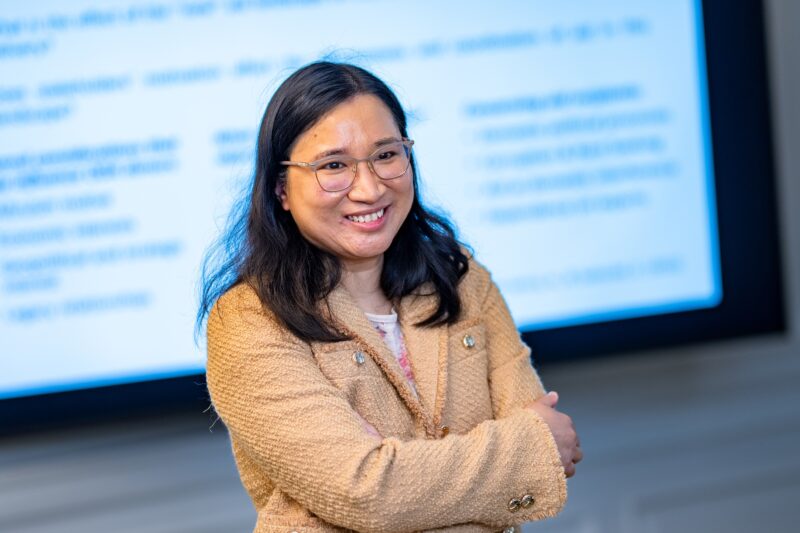
A Yale Jackson lecturer and economist, Hasanbasri explores why “who owns what” is harder to answer than it sounds — and why getting it right matters for women’s well-being across lower-income countries. She and colleagues present new measurement tools at a World Bank webinar on April 2.
Ardina Hasanbasri grew up in both Indonesia and the U.S., watching inequality up close and wondering how access to resources varies across and within nations. She found her answer in economics, where she could use her love of math to give structure to what she observed, and use development data to illuminate various patterns of human experience.
Now a lecturer at Yale Jackson, she studies asset ownership across lower-income countries — who has the power of ownership, what it means legally and culturally, and how to measure it across different contexts.
In a recent interview, Hasanbasri discussed her work on land ownership, including an April 2 presentation where she will share ownership measurement tools developed through the MAGNET (Measures for Advancing Gender Equality) initiative, and tested in India, Uganda, Tanzania, and other countries. MAGNET is a research collaboration that includes the World Bank’s Africa Gender Innovation Lab (AFRGIL) and Living Standards Measurement Study (LSMS) teams, the International Food Policy Research Institute (IFPRI), the International Rescue Committee (IRC), and researchers at various institutions.
How does the concept of ownership differ in the West versus a country like India or Tanzania?
In the U.S. and other Western countries, ownership is tied to documentation — a title for your house, a title for your car. The legal system is set up so that once you have that title, there’s no ambiguity in what you can or cannot do with your property. In places like India or much of Sub-Saharan Africa, documented ownership is not so common. Who owns land is often determined by customary rights which dictate social norms surrounding the transfer of land, inheritance customs, or decisions by local chiefs. Several government programs have started in the past few years to increase titling of land. When customary and formal legal systems co-exist, there can be ambiguity on what you can or cannot do with your land.
Land and housing are among the biggest assets most people will ever have. Research shows that owning property opens up opportunities — you can use it as collateral to start a business, make investments you otherwise couldn’t. But ownership also correlates with well-being in ways that go beyond economics. It makes people feel more secure, and affects decisions about things like children’s education. That’s why there’s so much focus on making ownership more equal, especially for groups that have historically been excluded.
What did your research reveal about women’s ownership specifically?
We wanted to go deeper than simply asking who holds the title or say they are owners. Even where women who claim to have ownership, social norms can limit what they can actually do with it. Tanzania is a good example. If you look at the percentage of people who own land, there’s no gender gap; but when you ask whether women can gift that land, or make improvements to it, gaps appear. Document ownership doesn’t automatically translate into the kind of ownership that produces the outcomes we care about.
Ownership questions can be very complex. In the case of a divorce, does a wife have any claim to land that was gifted to her, or inherited by the husband? In many contexts, the answer isn’t a clean yes or no. It depends on how the land was acquired, on local customs, on who you ask.
Does your research suggest policy interventions?
You can’t assume that what works in one country works in another — or even across regions within a country. For example, north and south India have very different attitudes toward women’s ownership.
The previous push has been toward documentation — putting both spouses’ names on the title, formalizing joint ownership. That makes sense on its face, but if norms and customs still require women to ask permission from a husband or in-laws before acting on that land, the document doesn’t change much. What our research suggests is that before designing a policy, you need to understand the landscape of ownership in a specific context. What does using land for collateral actually look like there? What assets matter most for well-being?
That last question produced one of our more surprising findings: in Uganda, transportation assets — vehicles, motorbikes — were strongly correlated with women’s well-being in a way they weren’t for men. If that’s the asset that matters, then policies aimed at making it easier for women to acquire transportation could have real impact.
What drew you to this work?
I always liked math because it has structure, and I also really like stories. I’m an avid reader, fiction and nonfiction. I love reading stories from different parts of the world and understanding how people live and see things. Growing up in a developing country like Indonesia and moving to the U.S., you see inequality, you see poverty, and you want to understand it, and figure out how to eliminate it. I think that’s how most development economists find their way in.
Economics felt like a tool where I could use the math to tell stories, but with enough structure to actually analyze the problem. It’s a bit like a puzzle: does the story fit the data? I want to tell stories through data — through interviewing people, through going into the field — and that’s kind of how I ended up here.
What will you be presenting on April 2?
The MAGNET initiative has been developing tools to help policymakers and practitioners measure different aspects of ownership. At the webinar, we’ll present those tools and share findings from piloting them across several country contexts. A key part of the work is validation — making sure the tools actually capture what they’re designed to capture. You can create any measure you like; what matters is whether it holds up in the field. We’re excited to show what these tools reveal about the nuances of ownership.