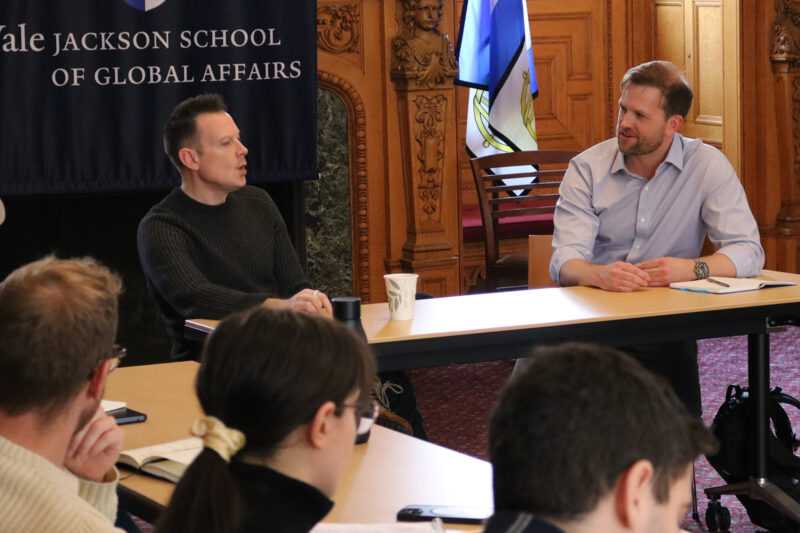
As both alum and lecturer, Matt Trevithick says his time at Yale Jackson helped him “connect the dots” and build Blank Slate, an AI-driven platform bringing cognitive-readiness tools to high-stakes industries.
Matt Trevithick is drawn to problems where failure is not an option. In zero-fail environments, the question is simple: how do you ensure the human mind performs reliably under pressure?
Trevithick ’20 is the founder and CEO of Blank Slate, an AI-driven platform focused on workforce cognitive readiness. The system models individual forgetting curves and uses adaptive algorithms to identify knowledge gaps and schedule targeted reinforcement, ensuring critical information is retained and accessible over time for teams operating in high-stakes settings, particularly across national security and aerospace. The company recently closed a strategic investment from a leading aerospace firm, underscoring its relevance in these environments.
The research foundation for Blank Slate was sharpened at the Yale Jackson School of Global Affairs, where Trevithick integrated nearly a decade of field experience with academic research. Prior to Yale, he co-founded SREO Consulting in 2013, supporting humanitarian and development organizations across the Middle East with research and data analysis. Earlier roles included work with the Woodrow Wilson Center and positions in the president’s offices of the American University of Iraq and the American University of Afghanistan.
“I had spent nine years working across Syria, Iraq, and Afghanistan,” Trevithick said. “Jackson allowed me to step back, connect a lot of varied dots, and turn that experience into something that laid the foundation for my next steps.”
At Yale, he worked in particular with senior lecturer Casey King — exploring the intersection of cognition, data, and memory — and professor Paul Kennedy, exploring the biggest themes of modern history. After graduating, he stayed an extra semester to pursue research with Arne Westad — an experience Trevithick described, humorously, as “bashing my head against a wall for a few months and failing catastrophically, maybe with a little bit of style, which I think amused him.”
The work with King led to a randomized controlled trial demonstrating that anticipated forgetting could be systematically and measurably reduced in cognitively healthy adults. The implications were immediate for high-risk environments: “fighter pilots, special operations, aerospace engineers — places where small errors compound quickly.”
“If you don’t know how to jump out of a plane, that’s a problem,” Trevithick said. “If you build a plane incorrectly, you’re in the news.”
The findings evolved into Blank Slate, now deployed as a performance system across defense, aerospace, and advanced manufacturing.
Trevithick leaned on Yale’s interdisciplinary ecosystem as Blank Slate took shape: some of the company’s first hires came from the nearby School of Management, reinforcing the mix of research, technology, and execution at the heart of the company, while an Eli Whitney student helped sharpen the thinking behind its mission.
The platform is designed to ensure that critical knowledge is retained and applicable when it matters most, including under stress. Beyond these applications, the underlying cognitive science has broader relevance. Trevithick said clients have already seen measurable improvements in performance, reductions in error rates, and lower training costs.
“In a moment defined by artificial intelligence, it’s exciting to use some of those same ideas to enhance human performance — because the decisive questions will always come back to how people think and act when it matters,” he said.
Trevithick has expanded the work into memory-related disorders, including Alzheimer’s disease, collaborating on follow-on research exploring how neuroplasticity-driven approaches can improve retention in clinical populations. “That’s the longer-term direction,” he said. “The same principles that matter in elite performance environments should translate to cognitive health more broadly.”
Trevithick returned to the Jackson School as a lecturer in 2024. In spring 2026, he is co-teaching “Field Operations in Global Affairs” with Senior Fellow Elliot Ackerman, a course focused on the practical mechanics of operating in complex environments, from working with governments and NGOs to engaging non-state actors.
“Jackson gave me the space to connect big ideas to real-world execution,” said Trevithick. “Coming back to teach, the focus is on closing that same gap for my students — how you actually operate in complex environments to drive progress, building on rigorous ways of thinking about them. That process of working through those challenges closely with students has been incredibly rewarding.”
Photo: Matt Trevithick (right) speaks with Nate Mook, former CEO of World Central Kitchen, during his class “Field Operations in Global Affairs” in spring 2026.