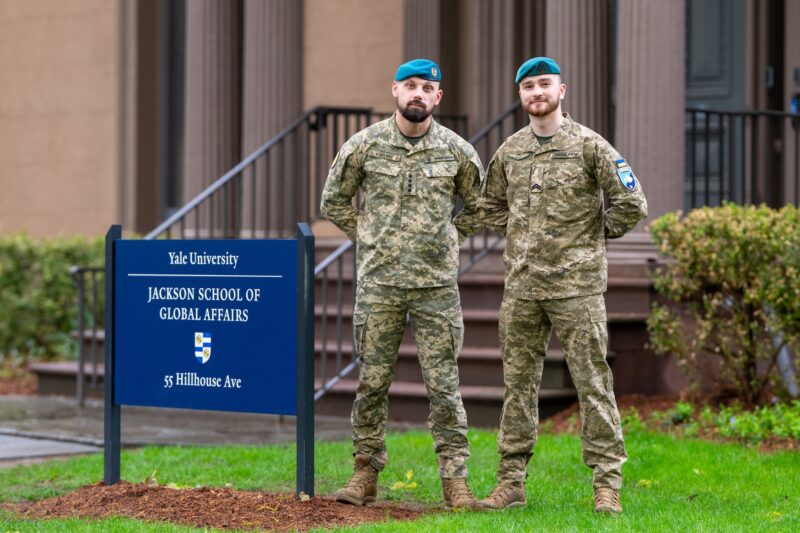
A new program with the Victor Pinchuk Foundation brought 15 Ukrainian veterans — soldiers, advocates, and policymakers in the making — to New Haven for a week of leadership training and exchange.
Yale Jackson welcomed a cohort of 15 Ukrainian veterans to New Haven April 26–30, 2026 for an intensive leadership program designed to build on what they have already demonstrated on the battlefield.
The group included a Marine who defended Mariupol and spent two and a half years in Russian captivity, a former film director turned drone operator, a medic credited with saving more than 200 lives, and a 24-year-old double amputee who returned to active duty while running a regional veterans’ NGO. Several participants were still in active service.

The Ukrainian Veterans Leadership Program drew on the school’s faculty and senior fellows across a week of sessions focused on historic leadership models, communication, ethics, and Ukraine’s future. Participants heard from a range of scholars and practitioners. Timothy Snyder, the Richard C. Levin Professor Emeritus of History and Professor Emeritus of Global Affairs, opened the program with a talk on the meaning of this moment in history. Yale Jackson senior fellow Robert Malley spoke about the changing dynamics of war and peace. Emma Sky and Yuval Ben-David of the International Leadership Center led a session on imagining scenarios for Ukraine in 2050. Yale School of Management senior lecturer Zoe Chance led workshops on message framing and leadership presence. Historian and Jackson senior lecturer Mike Brenes helped close the week with an interactive session on the future of Ukraine that echoed Snyder’s opening remarks. Each day concluded with After Action Reviews — structured debriefs familiar to military participants — facilitated by the program’s lead instructor, Yale Jackson lecturer Jimmy Hatch.
Hatch, a U.S. Navy SEAL veteran who took part in more than 150 direct action missions before a severe injury ended his military career in 2009, said the week challenged his own assumptions. “Built to teach Ukrainian veterans leadership and international relations, the program ended up teaching us,” he said. “After years at war, some still carrying their wounds, they refuse to wallow — they get after it, and they are the example.”
One session that made a particular impression was Chance’s workshop on message framing. “She focused on storytelling as part of leadership, as a way to bring people together around your mission and vision,” said Colonel Oleksandr Falshtynskyi, chief of the Medical Service of the 7th Air Assault Corps. “The instructors didn’t just share knowledge, but they went out of their way to put it in a really interesting way. It felt like we had a purpose in common, and agreed on some common conclusions.”
The group also praised Brandon Nappi from Berkeley Divinity School at Yale whose session on ethics, mindfulness, and transformative leadership helped them celebrate the values for which they are fighting.
Each morning at 9:00 a.m., participants and presenters observed a minute of silence — a practice that has become a national tradition in Ukraine.

“It’s a way to build a culture of memory,” said Khrystyna Boichuk, a Ukrainian National Guard officer who has served as a platoon leader and mortar battery deputy commander. “It’s a tradition to memorialize those who have fallen — who were killed by Russians.” Boichuk uses the time to think of her friend Iryna Tsybukh, a medic killed on May 29, 2024 on the front line near Kharkiv, days before her 26th birthday. “I think about Iryna, and all my brothers and sisters in arms, what they did and what they fought for.”
The program was a collaboration between Yale Jackson and the Victor Pinchuk Foundation. Victor Pinchuk, a Ukrainian businessman and philanthropist, established the foundation to support a wide range of charitable programs, with veterans’ initiatives serving as one of its key pillars. These include high-tech physical rehabilitation, mental health support for service members and their families, and communications efforts to share frontline insights with Western decision-makers.
“We are proud to welcome these veterans to Yale Jackson,” said Dean James Levinsohn. “Our faculty and senior fellows are leading experts in history, economics, political science, and the practice of global affairs — and they will offer participants a new perspective on both their past contributions and the paths ahead.”
